- Tree Pruning
- Tree Health
- Tree Care
- Texas Trees
Tree Pruning Done Right: A Texas Homeowner's Guide
Prune a tree by removing dead, damaged, and crossing limbs with cuts made just outside the branch collar, taking no more than about 25 percent of the live canopy in one growing season and never topping the tree.
Good pruning is one of the best things you can do for a tree, and bad pruning is one of the most damaging. The difference isn't the saw - it's knowing which branches to remove, exactly where to cut, and what time of year to do it. Here's how to get all three right.
What Is the Difference Between Tree Trimming and Pruning?
Trimming is about shape and clearance, and pruning is about health and structure - people use the two words interchangeably, but they solve different problems:
Trimming is about shape and clearance - lifting limbs off the roof, pulling growth back from the driveway, opening a sight line. The goal is how the tree fits the space around it.
Pruning is about health and structure - taking out what's dead or diseased, correcting a weak branch union before it fails, improving how the canopy handles wind. The goal is what the tree looks like in ten years, not next weekend.
A good crew does both in one visit but never confuses the two - trimming for clearance without thinking about structure is how a healthy tree ends up lopsided. Both are part of our tree pruning and tree trimming work.
The Four Cuts That Matter
Almost every worthwhile cut falls into one of four categories.
1. Deadwood Removal
Dead limbs don't come back, and they don't stay put. They dry out, get brittle, and eventually drop - usually in wind, usually onto whatever is below. Removing deadwood costs the tree nothing in stored energy, so it works in any season.
2. Crown Cleaning
Deadwood plus the other obvious problems: broken stubs from an old storm, diseased limbs, crossing branches that rub each other raw, and water sprouts shooting up from old cuts. It's the standard maintenance prune, and it's all most mature trees need.
3. Crown Thinning, Done Sparingly
Thinning means selectively removing a few live interior branches so light and air move through the canopy. Done lightly, it can ease the sail effect that catches wind. Done heavily, it backfires: you strip out the growth that feeds the tree, force weakly attached sprouts, and end up with a thin, whippy canopy instead of a stronger one.
4. Structural Cuts on Young Trees
This is the pruning almost nobody does, and it has the biggest payoff. On a young tree you want one dominant central leader, branches spaced along the trunk rather than clustered, and no codominant stems - two stems of roughly equal size splitting off with a tight V-shaped crotch. That union can trap bark inside the joint and become a classic failure point twenty years later.
The fix is usually a subordination cut: instead of removing the competing stem, you shorten it so the leader you want outgrows it. A few minutes with hand pruners now prevents a much bigger problem later.
Where Exactly Should You Cut a Branch?
The cut goes just outside the branch collar and never flush with the trunk, because trees don't heal wounds the way people do - they can't replace damaged tissue, so they wall it off and grow around it. That job depends on the branch collar, the slightly swollen ring of trunk tissue at the base of every branch.
A proper cut goes just outside the collar, leaving it intact. The tree then grows callus in from the edges and closes the wound over time. Two cuts break that process:
- Flush cuts slice into the collar, level with the trunk. They look neat, and they're the worse of the two: you've removed the tissue that closes the wound and opened the trunk to decay.
- Stub cuts leave inches of branch past the collar. The stub can't grow new tissue, so it dies back and decay works inward toward the trunk.
For any limb heavy enough to tear, use the three-cut method:
- Cut upward from the underside about a foot out from the collar, a third of the way through.
- Cut down from the top an inch or two farther out, so the limb drops without stripping bark down the trunk.
- Make the final cut just outside the collar, taking off the stub cleanly.
Skip step one and a falling limb can peel bark several feet down the trunk - a wound far worse than the pruning itself.
How Much of a Tree Can You Prune at One Time?
Remove no more than about 25 percent of a tree's live canopy in one growing season, because leaves are how a tree makes food. Take too many at once and you starve it - the result is stress, dieback, and weak sprout growth. The common working limit is no more than about 25 percent of the live canopy in one growing season - and most well-kept trees need far less than that.
| Tree situation | Live canopy to remove in one season |
|---|---|
| Young tree being trained for structure | Up to about 25 percent |
| Healthy mature shade tree | 10 to 15 percent is usually plenty |
| Older, stressed, or storm-damaged tree | Deadwood only, or very little live wood |
Dead limbs don't count toward that limit - you can take out every dead branch without touching the tree's food supply.
Topping and Lion-Tailing: The Two Worst Things You Can Do
Topping is cutting main limbs back to stubs to make a tree shorter. It doesn't make a tree safer - it makes it more dangerous. The tree answers with dozens of fast sprouts anchored only in the outer layer of wood, while the stub cuts never close and decay works down into the limb. A few years later you have heavy new growth standing on rotting wood. If a tree really is too big for its spot, the honest options are reduction cuts back to a suitable lateral branch, or removal.
Lion-tailing is stripping out interior growth so each limb ends in a puff of leaves at the tip. It's often sold as thinning, and it's the opposite of helpful: the weight shifts to the branch tips, the interior growth that fed and tapered the limb is gone, and what's left is a lever waiting for a gust. Our storm season tree preparation guide covers what actually helps a canopy handle wind.
Timing: When to Prune Along the Texas Coast
Dormant Season Is the Default
For most shade trees, late winter dormancy is the sweet spot: the leaves are off so structure is easy to read, pests and pathogens are far less active, and the tree pushes new growth right after the cut. Winter work also puts the job well ahead of hurricane season - June 1 through November 30, as the National Hurricane Center defines it.
Oaks Need Extra Care
Oak wilt is a fungal disease that kills oaks, and it spreads two ways: through connected root systems, and by sap-feeding beetles carrying spores to a fresh wound. Those beetles are most active in spring, so the standard guidance across Texas is to avoid pruning oaks in the high-risk window - roughly February through June - and to save the work for the cold of winter or the heat of midsummer.
Dead and Hazardous Limbs: Any Season
There's no wrong season to remove a dead, cracked, or hanging limb. A branch over a bedroom or driveway is a safety issue, not a horticultural one - it comes out now. Same for anything left hanging after a storm - here's what to do when a tree comes down.
When Should You Call a Pro Instead of Pruning It Yourself?
Call a pro once the cut is above head height, the limb is heavy enough to do damage, or power lines run anywhere near the work - hand pruners and a pole saw are fine only for small limbs you can reach with both feet on the ground. The job changes when any of this is true:
- The cut is above head height and you'd need a ladder to reach it
- The limb is heavy enough that where it lands is a decision, not an accident
- Something valuable is underneath - a roof, fence, car, pool, or neighbor's yard
- Power lines run anywhere near the work
- The limb is dead, cracked, or partly hung up, so it may move unpredictably
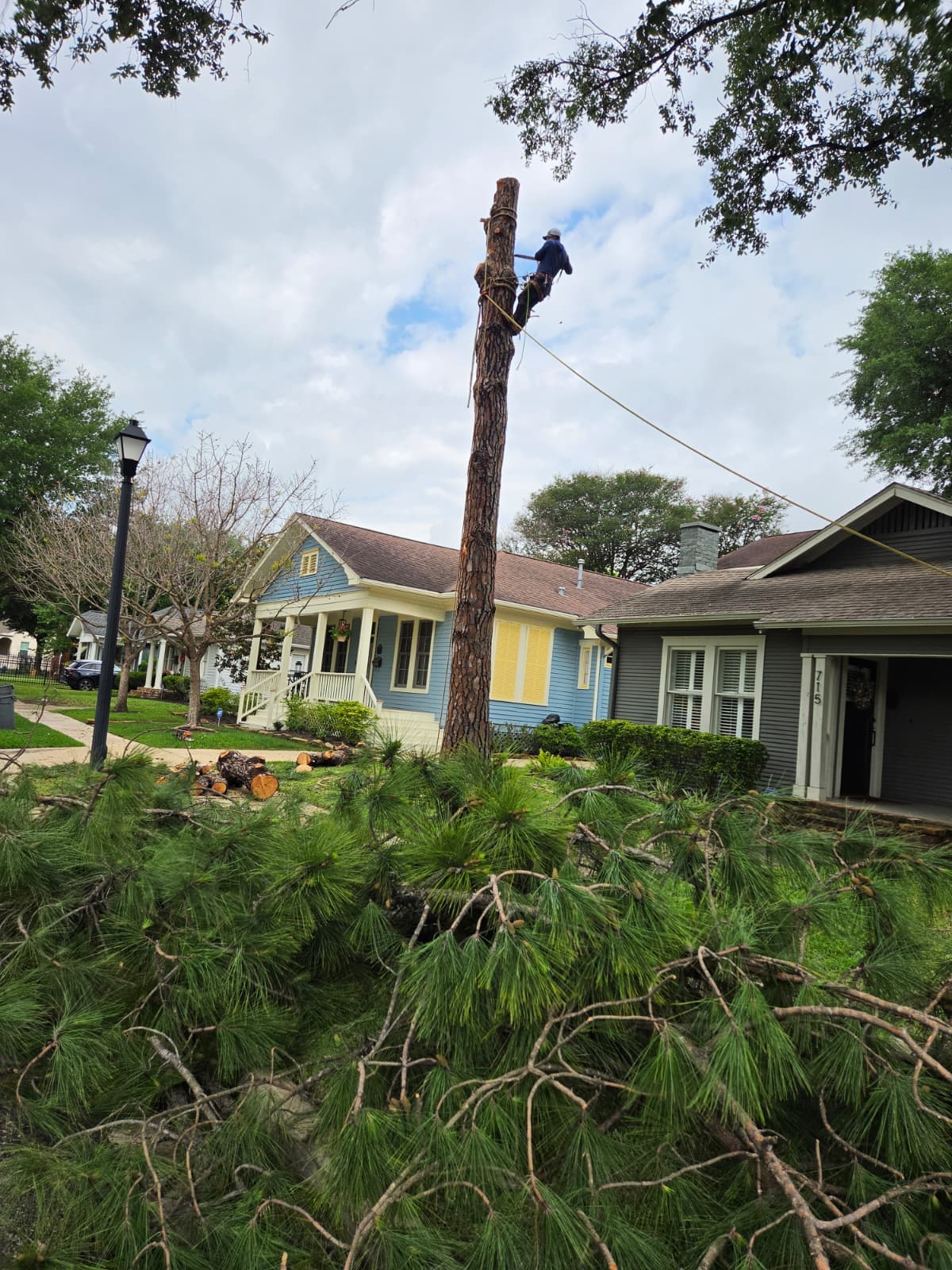
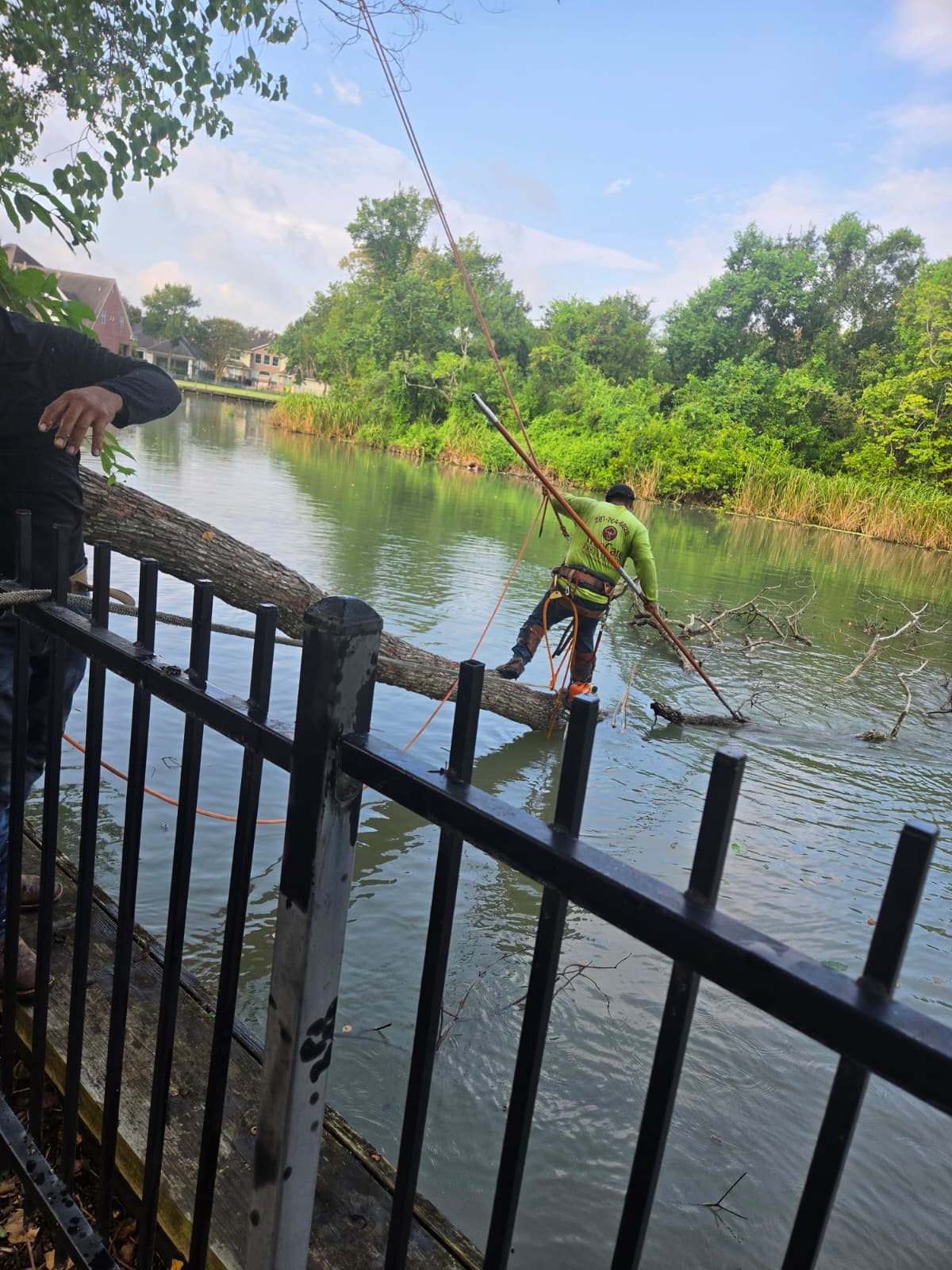
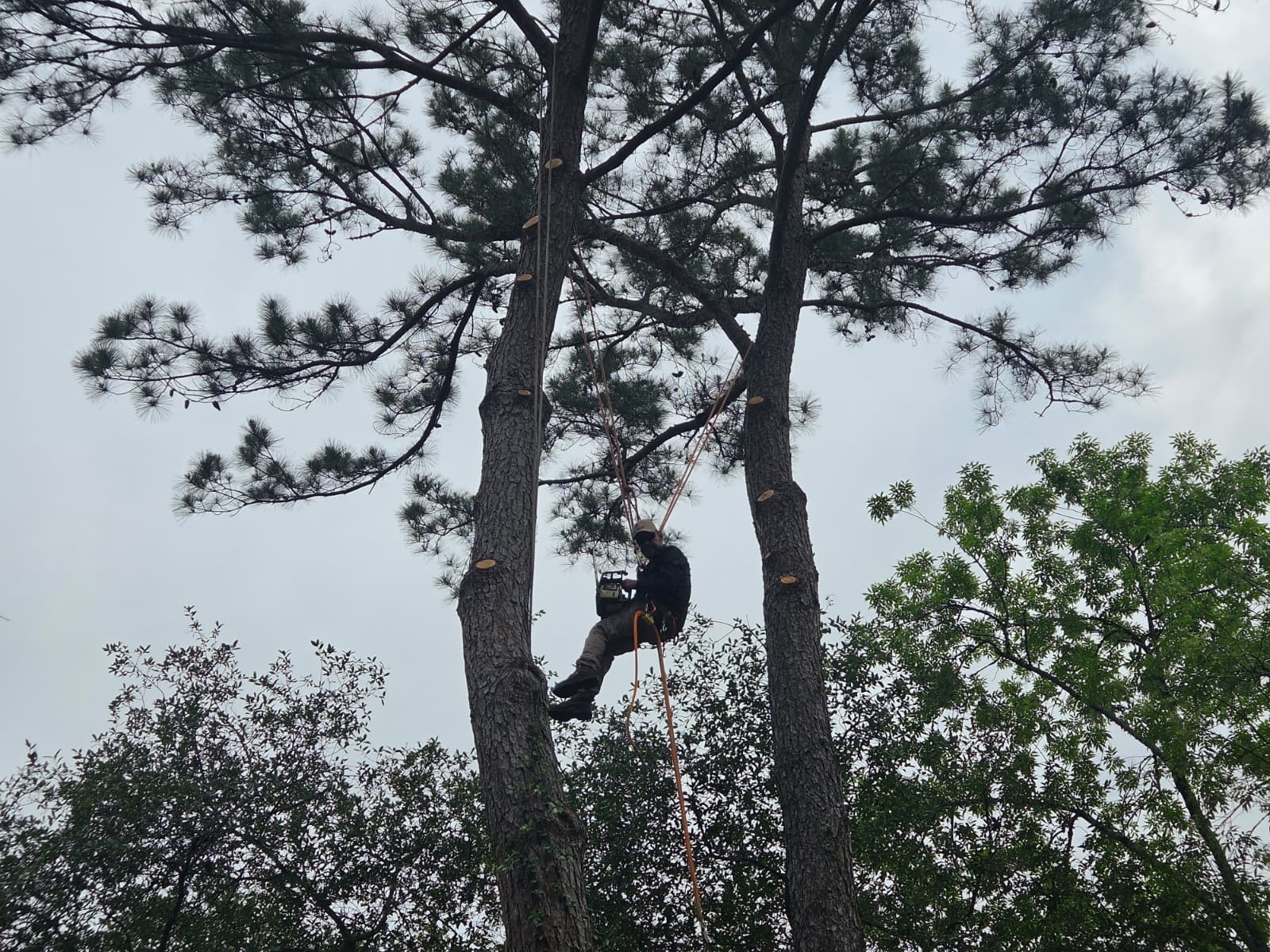
Ladders and chainsaws are a bad combination: a ladder needs the limb to stay still, and a limb under saw pressure rarely does. Work like that is done from inside the tree instead - a climber on rope can get into position for a clean cut outside the collar, and rigging lowers heavy pieces under control. You can see examples in our work.
Get a Second Opinion Before You Cut
If you're not sure whether your tree needs a light cleaning, real structural work, or nothing at all, ask before the saw comes out. We're insured, we work on both homes and commercial properties, and estimates are free. Send photos through our free estimate form or call (832) 272-4373 and we'll tell you straight what the tree needs - and if you'd rather talk it through in Spanish, hablamos espanol.
Common Questions
Frequently Asked Questions
How often should mature trees be pruned?
Most healthy mature shade trees need pruning every three to five years, while young trees benefit from a light structural check every one to two years. Fast-growing species and trees crowding a roof, driveway, or walkway may need attention sooner. In between visits, walk the yard after storms and look for dead, cracked, or hanging limbs, which can come out in any season.
Can a tree be saved after it has been topped?
Often yes, but it takes years of patient restoration pruning rather than a single visit. The work is spread over several seasons: thin the crowded weak sprouts that shot up from each stub, keep the strongest and best attached ones, and let them slowly rebuild a natural crown. A topped tree with heavy decay already working down into the old stubs may be past saving, and removal becomes the safer call.
Does homeowners insurance cover tree pruning?
Routine pruning is treated as homeowner maintenance, so policies generally do not pay for it. Coverage usually comes into play only after damage, such as when a tree or limb falls on a covered structure, and terms vary by policy and insurer, so read yours or ask your agent. Taking out deadwood before it falls is the part you can actually control.
What affects the cost of a tree pruning job?
Pruning cost tracks the difficulty of the work: the size and species of the tree, how much of the canopy needs attention, whether the work can be done from the ground or requires climbing and rigging limbs down, what sits underneath, and how close power lines run. Hauling the debris away factors in too, which is why no two jobs quote the same. Estimates are free, so call (832) 272-4373 and have your specific tree looked at.