- Emergency
- Tree Safety
- Storm Damage
- Tree Removal
Tree Fell on Your House? What to Do in the First Hour
In the first hour after a tree falls on a house, car, or power line, move everyone clear, treat every downed wire as live, call 911 for injuries, photograph the damage, and call an insured 24/7 emergency tree crew.
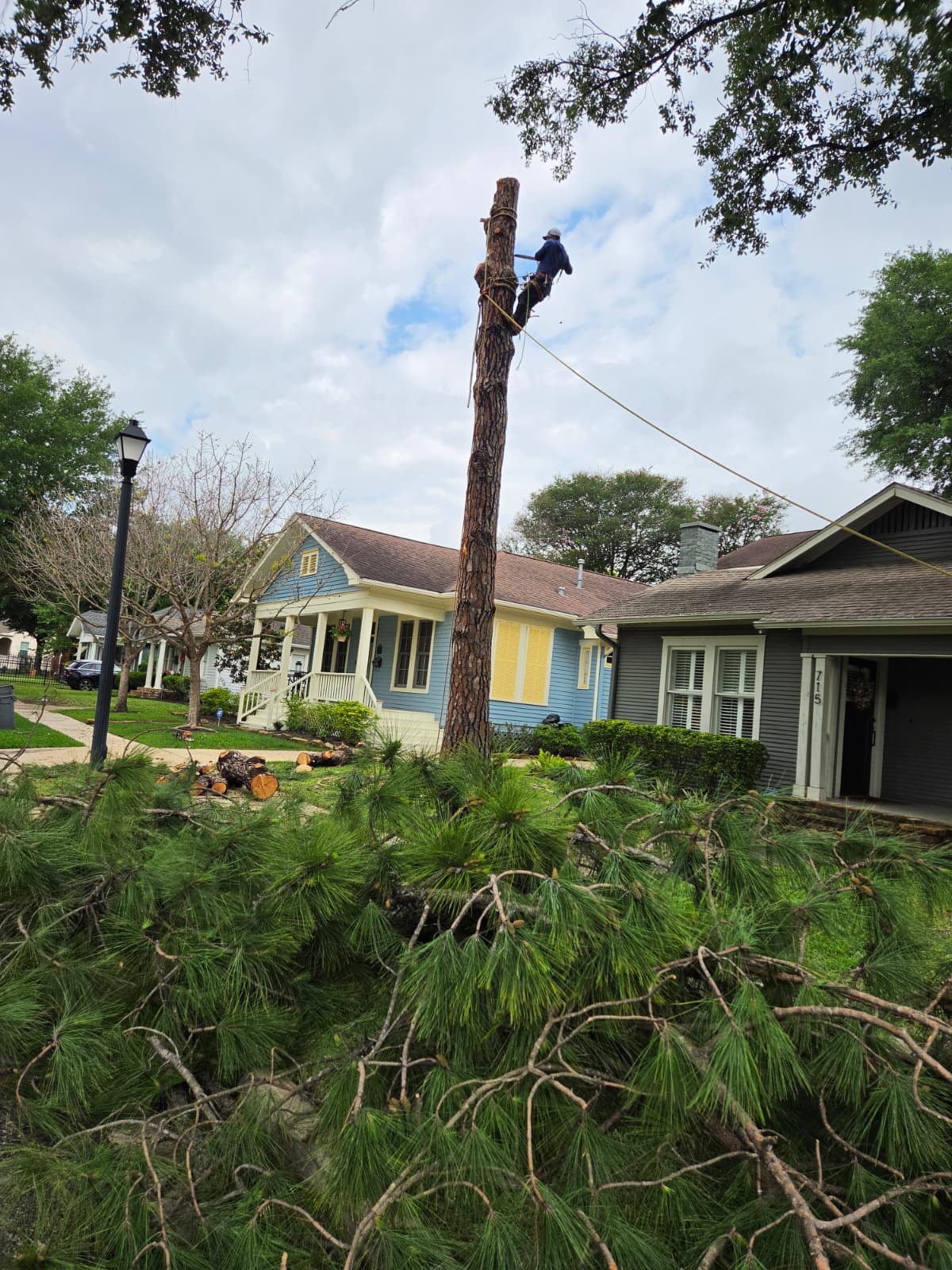
A tree on your roof, your car, or the line running to your house is one of the few home problems where the first hour genuinely decides the outcome. Handled right, it stays a property loss; handled wrong, it becomes an injury. Here is the order to do things in, what to leave completely alone, and what to have ready when you call for help.
What Should You Do in the First Hour After a Tree Falls?
In the first hour, get everyone clear of the tree and any wires, call 911 for injuries or fire, call your electric utility for anything involving lines, photograph the damage from safe ground, and then call an insured tree crew - in that order. Do not skip ahead to the cleanup.
- Get everyone out and away. Move people and pets off the impact side of the house - a neighbor's place, or the far side of the property.
- Do a headcount outside. Know where everyone is before you start making phone calls.
- Assume every downed or sagging line is live. Stay at least 35 feet back, the clearance utilities commonly advise. That includes lines in the yard, lines in standing water, and lines draped through branches.
- Call 911 for injuries, a gas smell, fire, or a line down across a road. Those are emergency-services problems first.
- Call your electric utility for anything involving wires. Only the utility can de-energize a line. No responsible crew, ours included, will cut a tree resting on an energized line until the utility clears the site.
- Stay off the roof. A tree strike can compromise decking and trusses you cannot see from the ground, and a wet roof is slick even where it is sound.
- Do not touch the tree or start a saw. Not to "take a little weight off," not to free a car door.
- Photograph everything before anything moves. More on that below.
- Call an insured tree crew and give them specifics. The more precise your description, the better equipped the truck that arrives will be.
Downed Lines Deserve Their Own Rule
Electricity does not need you to touch a wire. Current can travel out through wet ground, a chain-link fence, a metal gutter, and the tree itself - wood conducts far more readily when it is soaked with storm water. If you find yourself too close to a downed line, do not run. Shuffle away with your feet together and small steps until you are well clear.
If a line is down across your driveway and your car is under the tree, the car stays where it is. Anyone inside a vehicle that a line is touching should stay inside and wait for the utility unless there is fire.
Why Is a Fallen Tree More Dangerous Than It Looks?
A fallen tree is more dangerous than it looks because the forces that held it upright do not disappear when it comes down. A tree that has fallen is a loaded one. Trunks bridge across a fence or a roofline and bend like a drawn bow. Limbs pinned under the canopy hold enormous stored energy. Root plates that lifted out of saturated soil can drop back into the hole and take the trunk with them.
That stored energy is called spring tension, and it is why a first cut in the wrong place can send a log rolling, snap a limb up into someone's face, or bind a saw bar solid in half a second. It is also why chainsaw injuries are a well known hazard in the days after a storm across Texas and the Gulf Coast. The saws come out, the power is off, everyone wants the driveway back, and people who have never bucked a loaded log go to work on one in the dark.
There is a quieter risk too. A tree lying on a roof is often doing you a favor by staying put; dragging it off without support can pull sheathing, fascia, and gutters with it and turn a patch repair into a rebuild.
What Should You Photograph Before Anything Moves?
Photograph everything before anything moves, because your insurer will ask what the damage looked like before cleanup, and once a crew makes the site safe that evidence is gone. From safe ground, get:
- Wide shots from several angles showing the whole tree and the whole structure it landed on.
- The point of impact - roof, wall, window, fence, or vehicle.
- Interior damage, but only if the inside is safe to enter: ceiling stains, cracks, water coming in.
- The base of the tree, including the root plate or break point, if you can see it from a distance.
- Any vehicles, outbuildings, or fencing that got hit.
- A short video walkaround narrating the date and what you are seeing.
Do not climb, lean out a window, or step under the canopy for a better angle. A photo is never worth it. If a crew must move something to make the site safe, that is fine - safety comes before documentation.
Once the site is stable, a free estimate puts eyes on the property and gives you a clear read on the damage before you talk to your adjuster.
What Should You Have Ready When You Call a Tree Crew?
Have ready what fell, what it landed on, whether a power line is involved, whether anyone is hurt, how a truck can reach the property, and whether the tree is still settling, because dispatch is guesswork without those details. Having these ready is the difference between the right truck showing up and a second trip:
| What we ask | Why it matters |
|---|---|
| What fell - whole tree, major limb, or uprooted trunk | Sets the size of the job and the gear |
| What it landed on - roof, car, fence, driveway, open yard | Decides whether it gets rigged down or cut in place |
| Whether any power or utility line is involved | Determines whether the utility must clear the site first |
| Whether anyone is hurt or the structure is occupied | Changes the priority of the call |
| Access - gate width, overhead wires, soft ground | Tells us what equipment can reach it |
| Whether the tree is still moving or settling | Tells us how urgent the stabilization is |
If you are not sure about something, say so. A wrong guess costs more time than an honest "I can't see it from here."
What an Emergency Crew Actually Does on Arrival
The first thing a crew does is not cut anything. It is read the load: where the tension is, where the compression is, and what the structure does when each piece comes off. From there:
- Establish a work zone. People, vehicles, and pets out of the drop area.
- Confirm the utility status. Nothing near a conductor moves until that is settled.
- Stabilize before removing. Ropes, slings, and props take load off the structure so nothing shifts unexpectedly.
- Section under control. Pieces come off small, rigged to a line, and lowered rather than dropped. Over a roof, every piece is a controlled descent.
- Relieve tension deliberately. Bound limbs are released with the cut placed so the energy goes somewhere safe.
- Make it safe first, clean up second. At two in the morning, "done" means the danger is gone and your house is not taking on more damage. Stump grinding, limb cleaning, and landscaping repairs belong to daylight.
How Emergency Work Differs From Scheduled Work
Scheduled work is planned around the tree. Emergency work is planned around whatever the tree is currently doing to your property.
- The load dictates the sequence, not convenience. On a planned removal you choose where the pieces fall. On an emergency you take what the tension allows.
- Conditions are worse. Wind, rain, mud, darkness, no power. Everything takes longer and needs more eyes on it.
- It often takes more than one visit. Make the site safe now, then handle full cleanup and follow-up work like stump grinding, limb cleaning, or mulching once the ground dries out. You can see finished results in our work.
The Best Emergency Is the One That Doesn't Happen
Once your property is stable, ask why that tree came down. Storm failures usually start with something visible months earlier - a splitting co-dominant stem, a dead leader, decay at the base, or roots cut by a trench. A walkthrough before hurricane season, which the National Hurricane Center defines as June 1 through November 30 in the Atlantic basin, catches a lot of it. Our storm season tree preparation guide covers what to look for, and the pruning guide explains how correct cuts build trees that hold up better to Gulf Coast wind.
Call Us - We Answer 24/7
Romero Green Tree Service is insured, takes residential and commercial emergency calls, and answers them around the clock. If a tree is on your house, your car, or your driveway right now, call (832) 272-4373 and tell us what happened. If things are stable and you want a plan for the property, request a free estimate instead. And if you would rather talk it through in Spanish, we speak it - hablamos espanol.
Get everyone clear, stay away from the lines, and let us handle the rest.
Common Questions
Frequently Asked Questions
Does homeowners insurance cover emergency tree removal?
Emergency tree removal is often covered when the fallen tree damaged a covered structure such as a roof, garage, or fence, but coverage is decided by your carrier under your specific policy terms and most policies cap what they pay toward removal. A tree that came down in open yard with no structure damage is frequently treated differently. Notify your insurer as soon as everyone is safe, keep every invoice and work order, and ask what the policy requires before authorizing anything beyond making the site safe.
What does emergency tree removal cost after a storm?
Emergency tree removal is priced job by job, and the biggest factors are the size of the tree, what it landed on, whether the wood has to be rigged and lowered instead of dropped, and how close a truck can get to it. Work over a roof or near a line takes more equipment and time than a trunk lying in an open yard. Romero Green Tree Service offers free estimates, so the scope gets looked at before you commit.
Can a tree on my roof wait until morning?
No, a tree resting on a roof should be assessed right away, because the load can shift as wind, rain, and the tree's own weight work on decking and trusses you cannot see from the ground. Every hour it sits, more water gets into the opening it made. Romero Green Tree Service answers emergency calls around the clock at (832) 272-4373, and emergency work at night is about taking load off the structure and making the site safe, with full cleanup usually left for daylight.
What should I do if a tree is leaning but has not fallen yet?
Treat a shifted tree as an active hazard: keep people, pets, and vehicles out of a circle wider than the tree is tall, and do not try to rope, stake, or push it back upright. Fresh cracks in the soil, a root plate lifting on one side, or a lean that changed after a storm all mean the roots are already failing, and saturated ground plus another gust can finish it without warning. Romero Green Tree Service takes emergency calls around the clock at (832) 272-4373 when a leaning tree is over a house, a driveway, or a line.