- Storm Prep
- Tree Safety
- Hurricane Season
- Tree Trimming
- Emergency
Texas Storm Season: Prepare Your Trees Before the Wind
Preparing Texas trees for storm season means inspecting each tree for root plate movement, tight forks with included bark, deadwood, and past topping, then having a crew correct those weaknesses before hurricane season peaks from mid-August into October.
Texas storm season has a way of separating the trees that look fine from the trees that actually are fine. A tree can be full, green, and beautiful in July and still come down in September, because the things that make trees fail in high wind are usually invisible from your kitchen window. The good news is that most of those warning signs can be spotted from the ground, on a calm afternoon, long before a storm is on the map.
Why Do Healthy-Looking Trees Still Fail in High Wind?
Healthy-looking trees still fail in high wind because the defects behind the failure - a shifting root plate, a tight fork with included bark, deadwood, past topping - are easy to miss until you look for them, and the National Hurricane Center defines the Atlantic hurricane season as June 1 through November 30, with activity generally heaviest from mid-August into October. Wind by itself rarely takes down a sound tree - what takes trees down is wind plus a weakness that was already there. Here are the four that show up again and again after a storm.
Saturated Soil and Root Plate Failure
Heavy rain is the part homeowners underestimate. When soil is soaked, it loses its grip. The root plate - the wide, shallow mat of roots and soil that anchors the tree - can shift or lift as the trunk levers back and forth in the wind. This is why so many trees fall intact, with green leaves and no broken limbs. The tree didn't break. The ground let go.
Trees are especially vulnerable when roots were cut for a driveway, fence line, pool, or patio. A root system severed on one side can hold for years, then fail the first time wet soil and a sustained gust test it.
Co-Dominant Stems With Included Bark
Look at where the trunk splits. A fork into two stems of roughly equal size is generally weaker than a single trunk with branches coming off it. When bark gets pinched inside that V instead of the wood knitting together, it is called included bark, and it acts like a wedge. Storm wind pries the two stems apart, and half the tree ends up on the roof.
A tight V union on a large tree near the house is a classic storm failure point, and one of the most fixable - if it is addressed before the wind does it for you.
Deadwood You Stopped Noticing
Dead limbs don't bend. They snap, and in high wind they become projectiles. A limb dead for a season or two is dry, brittle, and going nowhere but down - and homeowners tune these out, because they have been there so long they look like part of the tree.
Topped and Lion-Tailed Canopies
Bad pruning creates hazards that take years to show up. A tree that was topped - cut back to stubs - responds by pushing out dense clusters of fast, weakly attached shoots. Those shoots get heavy, are anchored only at the edge of an old wound, and catch wind like a sail.
Lion-tailing is the opposite mistake: stripping out the interior growth so limbs carry foliage only at the tips. It looks tidy. It is not. All the weight ends up at the far end of a long lever arm - exactly where you don't want it in a gust. Both mistakes are covered in more detail in our guide to pruning trees the right way.
Your Walkable Pre-Season Inspection
Give yourself twenty minutes and a slow lap around the property. Look at each tree from two sides, and look up - most of what matters is above your head.
At the base and in the soil:
- Cracked, heaving, or mounded soil on one side of the trunk - a sign the root plate is moving.
- Mushrooms, shelf fungus, or hard woody conks on the trunk, base, or surface roots - often a sign of decay inside wood you can't see.
- Exposed, cut, or damaged roots from past construction, trenching, or hardscaping.
- Soft, crumbly, or hollow-sounding wood at the trunk flare.
On the trunk and main stems:
- A lean that is new or getting worse. Old leaners that have grown back upright are often stable; a fresh lean is not.
- Vertical cracks, seams, or splits, especially below a fork.
- Cavities, open wounds, or holes where limbs tore out.
- Tight V-shaped unions with bark pinched down inside them.
In the canopy:
- Dead limbs, bare branches with no leaves in midsummer, or broken limbs still hung up in the tree.
- Limbs directly over the roof, driveway, a bedroom, or the power drop running from the pole to the house.
- Branches rubbing the roof or siding.
- A canopy that is lopsided, or one side noticeably heavier than the other.
Write down what you find and which tree it is on - that list is exactly what you want in hand when you ask for a free estimate.
What Storm Prep Can You Do Yourself, and What Needs a Crew?
You can handle ground-level storm prep yourself - clearing brush, leaves, and small dead twigs within reach - so some of this is genuinely a weekend job. Some of it isn't.
| Task | DIY or Call a Crew |
|---|---|
| Clearing brush, leaves, and small yard debris | DIY |
| Small dead twigs within reach from the ground | DIY |
| Any cut that requires a ladder | Call a crew |
| Any limb over the roof, fence, or driveway | Call a crew |
| Anything within reach of the power drop or utility lines | Call a crew - and the utility |
| Large deadwood, hangers, or storm-damaged limbs | Call a crew |
| Reducing weight on a co-dominant stem | Call a crew |
| Removing a tree with root plate movement or basal decay | Call a crew |
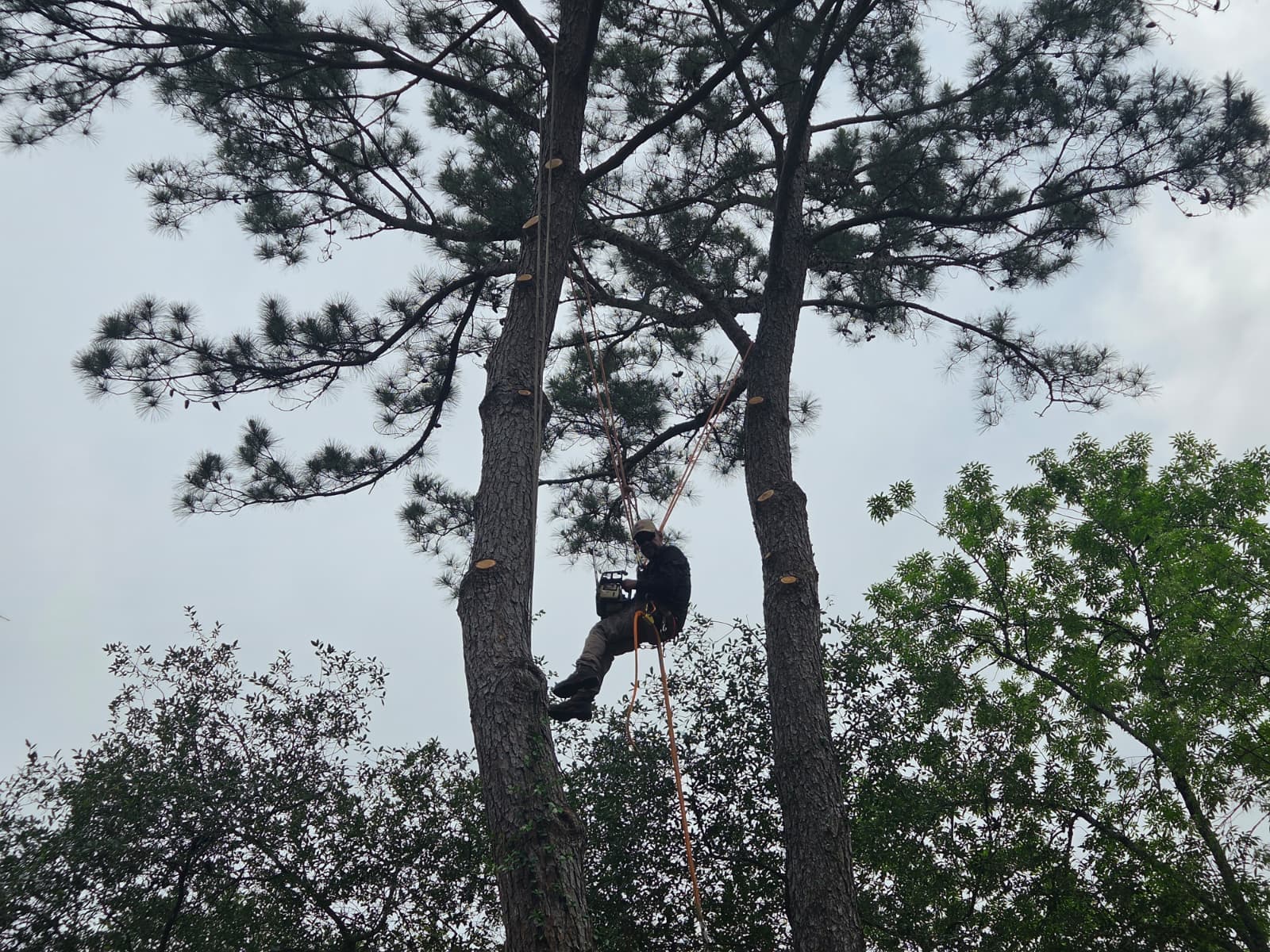
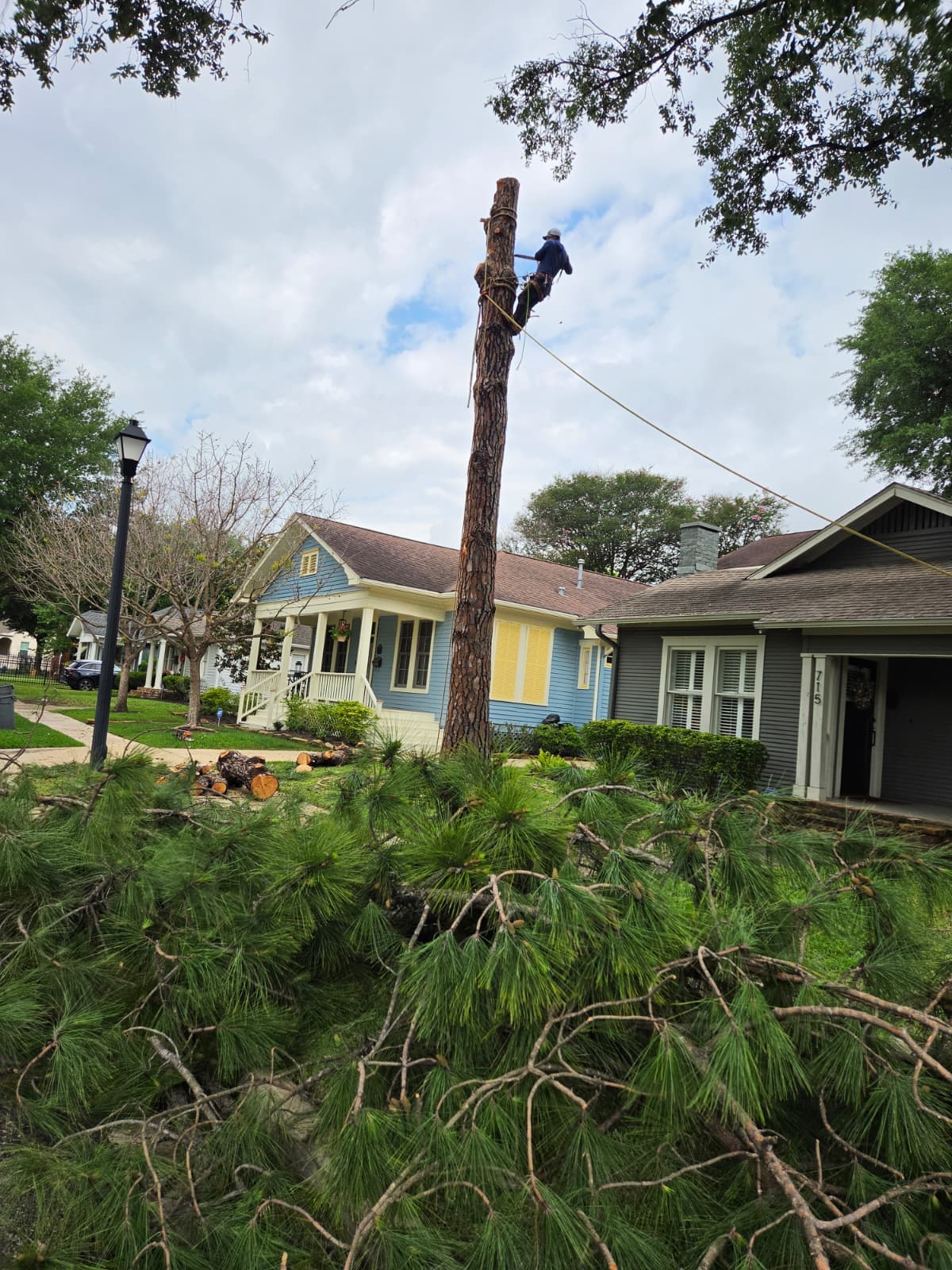
The honest rule: if the job needs a ladder, or a chainsaw above shoulder height, it isn't a homeowner job. Chainsaw injuries are common after storms - tired people, awkward angles, and wood under tension. Our crew covers the work above that line: tree trimming, pruning, limb cleaning, and tree removal when a tree is past saving. See examples of finished jobs in our work.
Does Topping a Tree Before a Storm Make It Safer?
Topping a tree before a storm does not make it safer, though every season someone decides to cut a tree way back so the wind can pass through it. The instinct makes sense; the result usually makes the tree more dangerous, not less.
Topping removes the leaves the tree feeds itself with, which weakens the root system that anchors it. It leaves large open wounds that let decay into the main stems. And the regrowth that follows is dense, fast, and attached only at the outer edge of the cut - more weight, held on more weakly, higher up.
What actually helps is structural work: removing deadwood, shortening overextended limbs to bring in end weight, thinning selectively so the canopy is balanced, and cleaning out crossing or rubbing branches. The tree keeps its shape and loses the parts most likely to fail.
What Should You Do in the 48 Hours Before a Named Storm?
In the 48 hours before a named storm, stick to fast ground-level work such as securing loose objects and clearing debris, and do no cutting or climbing at all, because once a storm has a name and a track, your options narrow fast. Tree crews get booked, and cutting in a rising wind is dangerous work.
If a storm is 48 hours out, focus on what is safe and fast:
- Bring in patio furniture, grills, planters, and anything else that can become a projectile.
- Clear loose brush, cut limbs, and yard debris - a pile of limbs is a pile of missiles.
- Clear gutters and drains so water moves away from the root zone.
- Photograph your trees and your property for insurance purposes.
- Park vehicles away from large trees and overhanging limbs.
- Follow official guidance at ready.gov and track the system at nhc.noaa.gov.
What you should not do is start cutting. Don't top a tree in a hurry, don't climb, and don't lean a ladder against a tree with weather coming. If a tree already looks compromised, treat the ground under it as off limits.
After the wind passes, keep people and pets away from leaning trunks, split forks, and limbs still hung up in the canopy - a tree that partly failed can shift again with no warning. If something has already come down, here is exactly what to do in the first hour.
Get Your Trees Looked At Before the Next System
Texas homeowners along the Gulf Coast know how fast a forecast can turn in late summer and early fall. You can't control the wind, but you can control how much dead weight and weak structure your trees carry into it - and that work goes better on a quiet weekday than in a rush. If your walk around the yard turned up a lean, a tight fork, a cavity, mushrooms at the base, or limbs over the roof, get eyes on it while the weather is calm. Romero Green Tree Service is insured, works on residential and commercial properties, and gives free estimates - and if you would rather talk it through in Spanish, we speak it, hablamos espanol.
Call (832) 272-4373 or request a free estimate. Keeping families safe through professional tree services starts with the trees you can still do something about.
Common Questions
Frequently Asked Questions
When should I have my trees trimmed to get ready for storm season?
Schedule structural storm-prep work well before the peak of the season, and remove deadwood any time you spot it. The Atlantic hurricane season runs June 1 through November 30 and is generally busiest from mid-August into October, so waiting until a system is on the map leaves very little room. Oaks are the exception: they are generally best pruned in winter dormancy, because oak wilt risk is highest in spring.
Does homeowners insurance pay for tree trimming before a storm?
Generally no - policies typically treat pruning or removing a healthy tree as routine maintenance, so preventive storm-prep work is usually an owner expense, while coverage more often applies to damage after a tree comes down. Terms vary by policy and carrier, so read yours or ask your agent before the season starts. Keep dated photos of your trees and property, since that documentation helps if you do file a claim later.
What determines the cost of storm-season tree work?
Cost tracks the size and condition of the tree, how close it stands to a house, fence, or power drop, how easily equipment can reach it, and how much debris the job leaves behind. A limb over a roof needs far more rigging and time than the same limb over open lawn. Romero Green Tree Service gives free estimates, so the practical step is to have the tree looked at in person and request one.
What should I do about the stump after a storm takes down a tree?
Grind it out rather than leaving it in place, since a standing stump can hold decay, draw insects, push up sucker growth, and sit in the yard as a tripping and mowing hazard. Stump grinding takes the wood down below grade so the spot can be filled in, replanted, or turned back into lawn. Romero Green Tree Service handles stump grinding along with removal and limb cleaning, and estimates are free - ask for one.